
$2.99
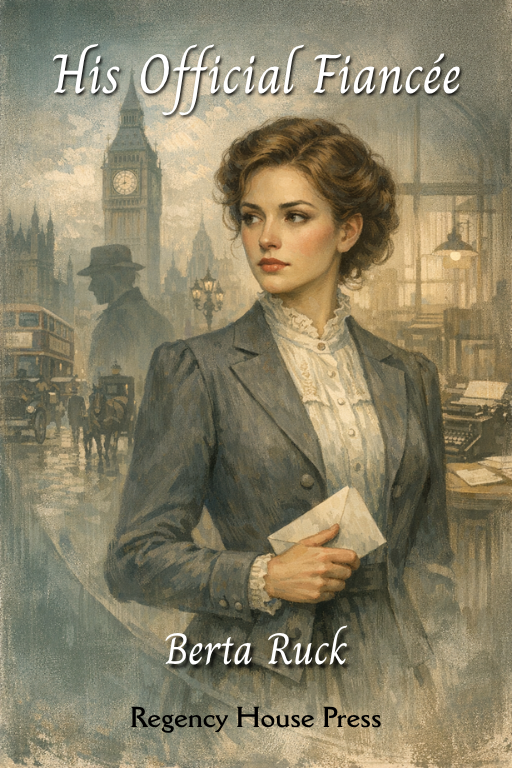
His Official Fiancee
Berta Ruck
British Romance
Publication Date
Synopsis
Monica Trant is a capable, working-class typist in pre-World War I London, whose genteel family has fallen on hard times. Monica and her colleagues don’t consider their employer, Mr. William Waters, an ordinary man but more like a working machine who barks out orders and gives them endless dictation. So, when Mr. Waters unexpectedly proposes that Monica pretend to be his fiancée for a year to satisfy social and business expectations, she is surprised but agrees because her family needs the money. Set in early 20th-century Edwardian London, the story plays with gender roles and class expectations as Monica navigates the awkwardness and complications of this strange arrangement. Her initial reluctance eventually gives way to curiosity about her own desires and personal worth, especially as she encounters actual potential suitors.
Novel Excerpt
Still Waters, of course (as his typists explain to each other at least four times in a morning), isn’t what you could call a man. Somehow, in surroundings that used to be more familiar to me than offices and City streets, I lost a little of that awe-struck nervousness of my employer. For a time I could almost forget he was that. He became—Well! he made me feel as I did in the old days when I had got someone very heavy-in-hand to take me in to dinner, or as if I were sitting out a dance with some rather hopeless partner. I mean that was about as far as any conversation between us went—a few stilted, distrait remarks, punctuating long stretches of silence.
Meanwhile, I glanced round the big place at the other luncheon-parties, people laughing and chatting together—out evidently for amusement, not “business”!
Several times I caught glances directed at our own table. I wondered what the people were thinking of us—of the enormously tall, fair young man with “City” stamped all over him, from his smooth head to his glossy boots, and the small, dark-eyed girl in the black velours hat which looked so very much more expensive and stylish than her neatly-cut but ancient serge costume would lead them to expect.
Perhaps they thought that the big young man with the face as expressionless as a fireproof curtain was slightly bored by taking his country cousin round the sights of London? Perhaps they thought we were really engaged? It didn’t matter. There was no one in the restaurant who knew either of us. Idly I wondered who would come in and take the “reserved” table close to us.
“Miss Trant, you took good care that the other typists knew for a fact with whom you were coming out?”
“Oh, yes. They were all looking out of the landing window as we drove off.”
“Good!” said Still Waters.
And again, I almost fancied that I caught that flash of something like humour in his granite-grey eyes, as I’d fancied it before, when he spoke about my “intelligence” and my work. But again, it was gone before I could make sure. I was glad. One doesn’t want a machine to have any sense of humour. And I shouldn’t find it so easy and unembarrassing to be on terms of “official fiancéedom” with anything but a machine.