
$2.99
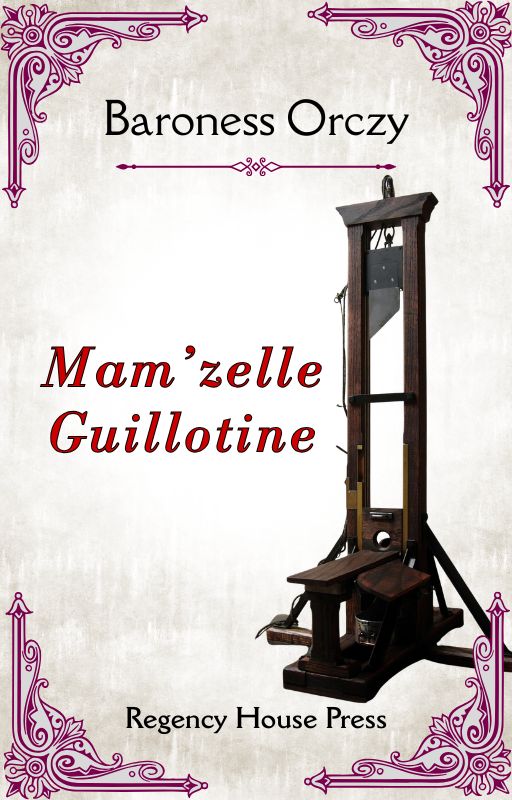
Mam’zelle Guillotine
Baroness Emma Orczy
Adventure Fiction
Published 1940
Synopsis
Mam’zelle Guillotine follows the turbulent life of Gabrielle Damiens during the French Revolution in the 1790’s. After her father is executed for attempting to assassinate the king, Gabrielle discovers letters that implicate aristocrats in the conspiracy and tries to blackmail them for personal advancement, only to be betrayed, imprisoned for sixteen years, and released during the storming of the Bastille. Freed into the chaos of revolution, she channels her rage into becoming France’s only female executioner—Mam’zelle Guillotine—feared throughout the land. The story intersects with the world of the Scarlet Pimpernel when English spies seek to save a noble family from her wrath. Gabrielle’s story arc, from victim to prisoner to instrument of revolutionary justice, underscores the consequences of justice, vengeance, and the human cost of societal upheaval.
Novel Excerpt
“Tell me more about that young woman, Blakeney. She interests me.”
It was the Prince of Wales who spoke. He was honouring Sir Percy and Lady Blakeney with his presence at dinner in their beautiful home in Richmond. The dinner was over; the ladies had retired leaving the men to enjoy their port and their gossip. It had been a small and intimate dinner-party and after the ladies had gone only half a dozen men were left sitting round the table. In addition to the host and the royal guest, there were present on this occasion four of the more prominent members of that heroic organization known as the League of the Scarlet Pimpernel: Lord Anthony Dewhurst, my Lord Hastings and Sir Philip Glynde, also Sir Andrew Ffoulkes, his chief’s right hand and loyal lieutenant, newly wed to Mademoiselle Suzanne de Tournay, one of the fortunate ones whom the League had succeeded in rescuing from the horrors of revolutionary France.
Without waiting for a reply to his command, His Royal Highness went on meditatively:
“I suppose Paris is like hell just now.”
“With the lid off, sir,” was Blakeney’s caustic comment.
“And not only Paris,” Sir Andrew added; “Nantes under that fiendish Carrier runs it close.”
“As for the province of Artois—” mused my Lord Hastings.
“That is where that interesting young woman takes a hand in the devilish work, isn’t that it, Blakeney?” the Prince interposed. “You were about to tell us something more about her. I confess there is something that thrills one in that story in spite of oneself. The idea of a woman—”
His Highness broke off and resumed after a moment or two:
“Is she young and good-looking?”
“Young? No sir,” Blakeney answered. “Nearer forty than thirty, I should say.”
“And not good-looking?”
“She must have been at one time. But sixteen years in the Bastille has modified all that.”
“Sixteen years!” His Highness ejaculated. “What in the world had she done?”
“It has been a little difficult to get to the bottom of her story. But I was interested. So were we all, weren’t we, Ffoulkes? As you say, sir, there is something thrilling-horrible really-in the idea of a woman performing the revolting task of a public executioner. For that is Gabrielle Damiens’s calling at the moment.”