
$2.99
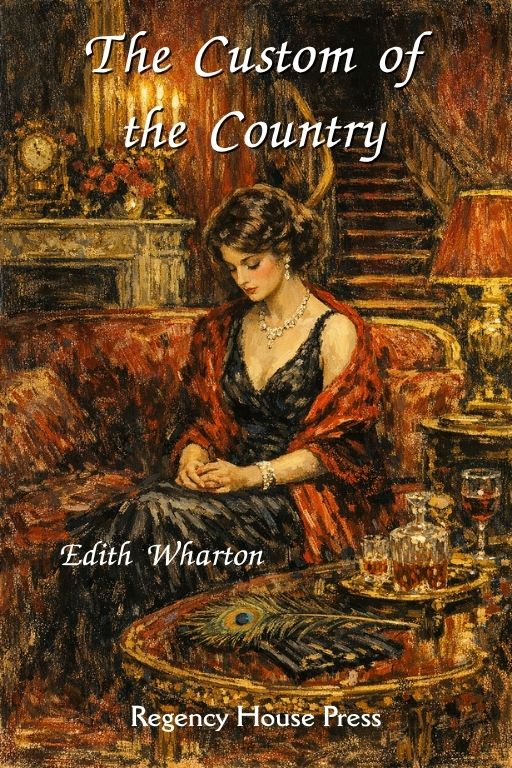
The Custom of the Country
Edith Wharton
Social Satire
Published 1913
Synopsis
A satirical social novel, The Custom of the Country follows the relentless social climber Undine Spragg, a young woman from the Midwest determined to secure wealth and status through advantageous marriages. After arriving in New York with her affluent but uncultured parents, Undine rapidly cycles through husbands – including the earnest old-money lawyer Ralph Marvell and the opportunistic Elmer Moffatt – always restless for the next opportunity to elevate her social position. Her ambitions are driven by materialism and insecurity, which contrasts sharply with the established elites who value tradition and social refinement. Undine’s pursuit of glamour and recognition exposes the superficiality of early 20th century American high society and the corrosive effects of consumerism on personal relationships. Throughout her marriages, geographic shifts between America and Europe underscore her restlessness and inability to find genuine fulfillment. Ultimately, Undine’s conquests leave her with emotional emptiness and disrupted personal bonds, exemplifying the desolation of unchecked social ambition.
Novel Excerpt
Undine, as a child, had taken but a lukewarm interest in the diversions of her playmates. Even in the early days when she had lived with her parents in a ragged outskirt of Apex, and hung on the fence with Indiana Frusk, the freckled daughter of the plumber “across the way,” she had cared little for dolls or skipping-ropes, and still less for the riotous games in which the loud Indiana played Atalanta to all the boyhood of the quarter.
Already Undine’s chief delight was to “dress up” in her mother’s Sunday skirt and “play lady” before the wardrobe mirror. The taste had outlasted childhood, and she still practised the same secret pantomime, gliding in, settling her skirts, swaying her fan, moving her lips in soundless talk and laughter; but lately she had shrunk from everything that reminded her of her baffled social yearnings. Now, however, she could yield without afterthought to the joy of dramatizing her beauty. Within a few days she would be enacting the scene she was now mimicking; and it amused her to see in advance just what impression she would produce on Mrs. Fairford’s guests.
For a while she carried on her chat with an imaginary circle of admirers, twisting this way and that, fanning, fidgeting, twitching at her draperies, as she did in real life when people were noticing her. Her incessant movements were not the result of shyness: she thought it the correct thing to be animated in society, and noise and restlessness were her only notion of vivacity.
She therefore watched herself approvingly, admiring the light on her hair, the flash of teeth between her smiling lips, the pure shadows of her throat and shoulders as she passed from one attitude to another. Only one fact disturbed her: there was a hint of too much fulness in the curves of her neck and in the spring of her hips. She was tall enough to carry off a little extra weight, but excessive slimness was the fashion, and she shuddered at the thought that she might some day deviate from the perpendicular.