
$2.99
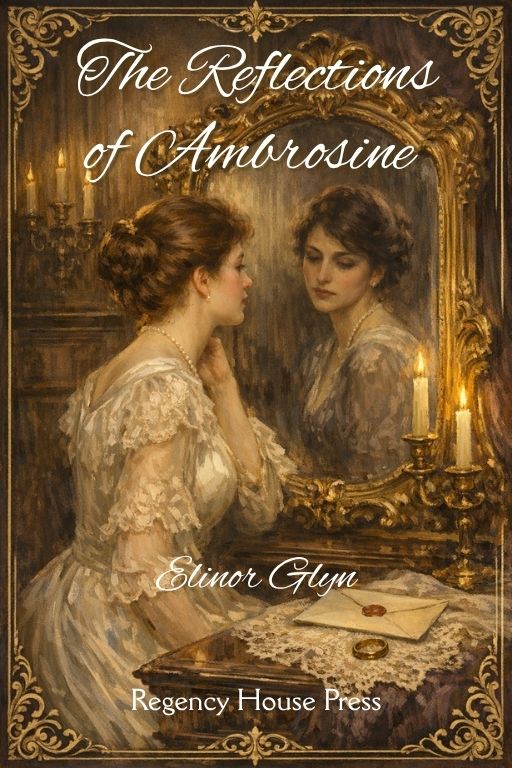
The Reflections of Ambrosine
Elinor Glyn
Society Romance
Published 1902
Synopsis
The Reflections of Ambrosine follows Ambrosine, a proud but impoverished young woman descended from aristocratic lineage whose life is shaped by financial misfortune and the familial expectations of Edwardian England. After her family’s fall from wealth, she lives with her strict grandmother who attempts to mold Ambrosine’s values and secure a socially advantageous marriage. Ambrosine’s relationships develop as she contemplates her personal identity, her social standing, and the tension between her romantic ideals and the ever-present family pressures. She meets various suitors such as Augustus Gurrage, a man of middle rank and unsympathetic character, and the more intriguing Marquis de Rochermont and Sir Antony Thornhirst. The novel probes how aristocratic descent and diminished financial means affect self-worth and societal standing.
Novel Excerpt
I do wonder and wonder at things sometimes: what it would be like to be rich, for instance, and to have brothers and sisters and friends; and what it would be like to have a lover à l’anglaise. Grandmamma would think that dreadfully improper until after one was married, but I believe it would be rather nice, and perhaps one could marry him, too. However, there is not much chance of my getting one, or a husband either, as I have no dot.
We have an old friend, the Marquis de Rochermont, who pays us periodical visits. I believe long ago he was grandmamma’s lover. They have such beautiful manners together, and their conversation is so interesting, one can fancy one’s self back in that dainty world of the engravings of Moreau le Jeune and Freudenberg which we have. They are as gay and witty as if they were both young and his feet were not lumpy with gout and her hands crooked with rheumatism.
They discuss morals and religion, and, above all, philosophy, and I have learned a great deal by listening. And for morals, it seems one may do what one pleases as long as one behaves like a lady. And for religion, the first thing is to conform to the country one lives in and to conduct one’s self with decency. As for Philosophy (I put a great big “P” to that, for it appears to be the chief)—Philosophy seems to settle everything in life, and enables one to take the ups and downs of fate, the good and the bad, with a smiling face. I mean to study it always, but I dare say it will be easier when I am older.
On the days when Monsieur de Rochermont comes grandmamma wears the lavender silk for dinner and the best Alençon cap, and Hephzibah stays so long dressing her that I often have to help the servant to lay the table for dinner. The Marquis never arrives until the afternoon, and leaves within a couple of days. He brings an old valet called Theodore, and they have bandboxes and small valises, and I believe—only I must not say it aloud—that the bandboxes contain his wigs. The one for dinner is curled and scented, and the travelling one is much more ordinary. I am sent to bed early on those evenings.