
$2.99
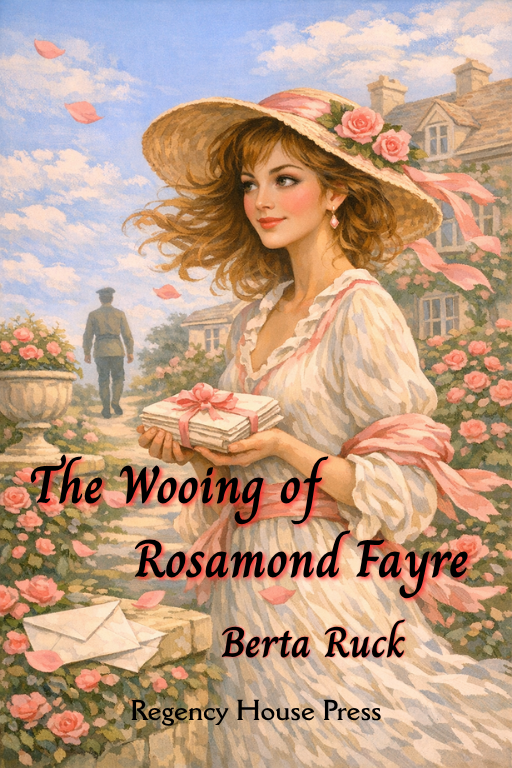
The Wooing of Rosamund Fayre
Berta Ruck
Historical Romance
Published 1914
Synopsis
The Wooing of Rosamond Fayre centers on Rosamond Fayre, a bright and self-reliant young secretary working for her friend Eleanor whose romantic correspondence with her fiancé, Ted Urquhart, initiates a case of mistaken identity and unintended attraction. Originally set in peaceful English country life at Urquhart’s Court, the story moves to a French seaside village, capturing both idyllic social settings and underlying tensions on the eve of World War I. Rosamond’s accidental involvement in Ted’s affections, arising from her role writing letters for Eleanor, propels him into pursuing her, unawares of her true identity. There are humorous misadventures between the working girls and eclectic villagers until events around the coming global war begin to intrude.
Novel Excerpt
Of all the duties which Rosamond Fayre had so far performed in her capacity as secretary and right-hand woman to her friend Eleanor Urquhart, she most enjoyed accompanying her on that trip to the Holiday Hostel in the little fishing-village on the still so peaceful French coast.
Rosamond adored France, the land known to Sir Philip Sidney as “that sweet Enemy!” the country that even in the June before the War was friendly ground to an Englishwoman.
She loved to wake up to find people—different in look and dress from people at home—doing unusual things at unusual times. She loved that unfamiliar atmosphere of roasting coffee, combined with the smell of sun-on-seaweed. She loved the clack of a foreign tongue. She loved to feel that higher tide of gaiety and vitality which seems to sweep the other side of the Channel only. She loved the little village with its busy “door-step” life; she loved to see the fisher-women, in their little white sun-bonnets, sitting mending their nets in the cobbled yards; the children, with their burnt-straw-coloured hair cropped to the bone, shrimping for “crevettes” in the rock-pools; the smart French visitors—little girls dressed as sailor-boys, plump mammas who appeared at their hotel doors at eleven o’clock in the morning dressed in white bed-jackets, over bright satin tango-petticoats; and she particularly enjoyed all these details in the society of Eleanor’s girls, upon whom they were dawning for the first time.
“Eleanor’s girls,” for whom the house built by an artist at the other end of the village had been converted into a Hostel, were to be brought over, six at a time, during the summer months. There were at present, however, only five of them. The sixth candidate was an English milliner’s assistant who worked in a Paris hat-shop, and, as Eleanor had only heard of her by letter, and as she (who had accepted a husband by letter only) preferred to select her “girls” by a personal interview, she had judged it better to make a short trip to Paris, combining a commission of her father’s with regard to some rare Rosicrucian documents with some personal enquiries as to the young shop-girl.
Thus it was that, for a whole week, Rosamond was left in charge of the Hostel and of the five girls.
Now, these girls, who were any age from nineteen to thirty, and who were treated by strict little Eleanor Urquhart as if they were children, treated her in turn as if each one of them were her devoted nurse. They admired her—immensely; but not for the qualities on which she prided herself; not for her managing powers, not because she could arrange with railway companies and steamship authorities to give them trips abroad on money which they could not have made go further than a week-end at Clacton, but because that sort of child-like, incomprehensible innocence of hers seemed to set her apart from them and above them. Instinctively they checked any “rowdiness,” they “censored” conversation, expressions, risky songs, when Miss Urquhart was near. For in the three great divisions of girlhood one finds, in nine cases out of ten, the Potential Mother and the Potential Coquette alike ready to pay homage to the Potential Nun.
Yes; Miss Urquhart they revered—and obeyed. Rosamond they loved; Rosamond, who could trim hats for them, and play tango-music, and tell fortunes, and advise them with regard to that question of perennial poignancy—their young men.